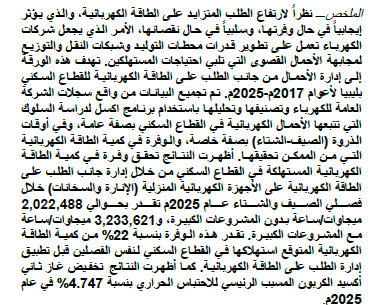
إدارة جانب الطلب على الطاقة الكهربائية للقطاع السكني بليبيا
DOI:
https://doi.org/10.36602/ijeit.v3i2.445Abstract
Downloads
References
[1] Gellings, C.W, and J.H. Chamberlin, 1993. Demand side management: concepts and methods.
[2] Maharjan, I.K., 2010. Demand side management: load management, load profiling, load shifting, residential and industrial consumer, energy audit, reliability, urban, semi-urban and rural setting: LAP Lambert Academic Publ
[3] تقارير الشركة العامة للكهرباء، 2005م-2016م.
[4] Bakr, S.A.B.,2012. Design, simulation, and emulation of a residential load management algorithm utilizing a proposed smart grid environment for the mena region. CU Theses, 2012.
[5] Kumar, A., S.K. Jain, and N. Bansal, 2003. Disseminating energy-efficient technologies: a case study of compact fluorescent lamps (CFLs) in India. Energy Policy, 31(3): p. 259-272.
[6] Abdunnabi, M. and D. 2014. Loveday, In–Situ Measurements of the Performance of Thermosyphon Solar Water Heating Systems in Libya. Solar Energy and Sustainable Development, 3(1), p: 123-131.
[7] خيري قاسم آغا، محمد خلاط، رمضان على بديوي،2009. إمكانية مساهمة الطاقة الشمسية في تسخين المياه المنزلية، الجدوى الفنية والاقتصادية، الجهاز التنفيذي للطاقات المتجددة.

Downloads
Published
License
Copyright (c) 2017 The International Journal of Engineering & Information Technology (IJEIT)

This work is licensed under a Creative Commons Attribution-NonCommercial-NoDerivatives 4.0 International License.