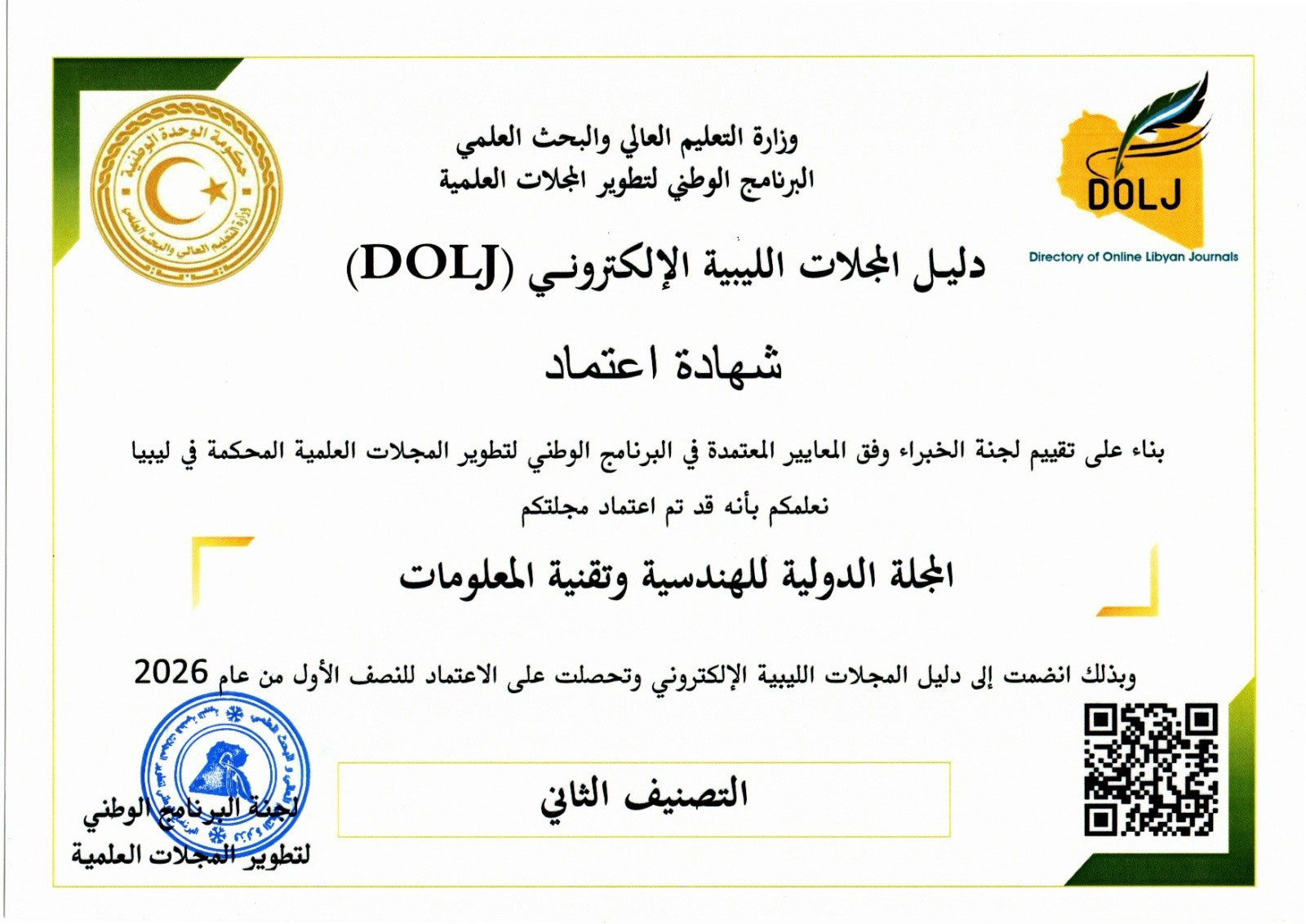
Carbon Footprint Assessment of an Industrial Technical College in Misurata -Libya Using the GHG Protocol (Scope 1 & 2)
DOI:
https://doi.org/10.36602/ijeit.v14i2.632Keywords:
Carbon footprint; Higher education institution; Scope 1 and 2 emissions; Energy consumption; Carbon management.Abstract
This study presents a comprehensive carbon footprint assessment of the Industrial Technical College in Libya, focusing on Scope 1 and Scope 2 greenhouse gas emissions. Activity data were collected for electricity consumption, diesel fuel use in backup generators, and gasoline use for college-owned vehicles, with annual totals for 2025 serving as the basis for calculations. Emissions were quantified using internationally recognized methodologies, including the GHG Protocol and IPCC guidelines.
The total annual carbon footprint was estimated at approximately 349.74 tCO₂e, with purchased electricity accounting for ~95% of the total, while diesel generators and institution-owned vehicles contributed minor fractions. Benchmarking against comparable international institutions confirmed that the emission pattern aligns with expected trends for technical colleges, despite the lower absolute totals due to smaller campus scale and limited operational intensity.
The study identifies electricity consumption as the primary emission hotspot and proposes targeted mitigation strategies, including renewable energy integration, energy efficiency improvements, and optimized transportation practices. The findings provide a robust baseline for institutional sustainability planning and emphasize the importance of carbon management in higher education settings, offering guidance for similar colleges and universities in Libya and other developing regions.
Downloads
References
[2] Klein-Banai, C.; Theis, T.L. Quantitative analysis of the carbon footprint of higher education institutions: A review. J. Clean. Prod., 2021, 283, 124614.
[3] Li, H.; et al. Carbon Footprint Assessment in Higher Education Institutions: A Meta-Analysis. J. Clean. Prod., 2023, 412, 137330.
[4] Wiedmann, T.; Minx, J. A Definition of 'Carbon Footprint'. Ecol. Econ. Monogr., 2022, 1, 1–11.
[5] Ghosh, R.; et al. Carbon Footprint of Engineering Campuses: A Multidisciplinary Evaluation. Environ. Impact Assess. Rev., 2023, 101, 107124.
[6] Chen, X.; et al. Carbon accounting frameworks for academic institutions: A systematic review and future research agenda. Sustainability, 2024, 16.
[7] Aquino, J.; Bedia, S.C.; Ruiz, M.C.; Zornosa, A.M. A study on the carbon footprint of a Philippine higher education institution using streamlined life cycle assessment. Chem. Eng. Trans., 2024, 113, 43–48. https://doi.org/10.3303/CET24113008
[8] Tırınk, S.; Aykaç Özen, H. Determination of Carbon Footprint at Institutions of Higher Education: The Case of the Iğdır University. J. Inst. Sci. Technol. 2023, 13, 2532–2545. https://doi.org/10.21597/jist.1387681
[9] Paredes-Canencio, K.N.; Lasso, A.; Castrillon, R.; Vidal-Medina, J.R.; Quispe, E.C. Carbon footprint of higher education institutions. Environment, Development and Sustainability, 2024, 26, 30239–30272.
[10] Yazici Güvenç, S.; Canikli, S.; Can-Güven, E.; Varank, G.; Akbaş, H.E. The carbon footprint of a university campus: Case study of Yildiz Technical University, Davutpaşa Campus, Turkey. Visions for Sustainability, 2023, 20, 189–221. doi: 10.13135/2384-8677/7317.
[11] Misni, A.; Buyadi, S.N.A.; Kamaruddin, S.M.; Ahmad, P. Quantifying Carbon Footprint Review in University Campus. Environ. Behav. Proc. J., 2019, 4, 133–138.
[12] Deda, D.; Gervasio, H.; Quina, M.J. Advancing carbon footprint in higher education: an integrated assessment model. Int. J. Life Cycle Assess., 2025, 30, 1930–1943.
[13] Roknaldin, A.; Kruke, L.; Qiao, A.; John, R.S.; von Winterfeldt, D. Reducing carbon emissions from student commuting in higher education. Environ. Syst. Decis., 2025, 45, 5.
[14] Lin, X.; Cai, H.; Zhao, S. An Empirical Analysis of Carbon Emissions in Higher Education Institutions: A Case Study of Zhejiang Ocean University Using Emission Factor Methodology. Sustainability, 2024, 16, 9412.
[15] World Resources Institute (WRI); World Business Council for Sustainable Development (WBCSD). The Greenhouse Gas Protocol: A Corporate Accounting and Reporting Standard, Revised Edition; WRI/WBCSD: Washington, DC, USA, 2004.
[16] Nassar, Y.F.; Salem, M.A.; El-Khozondar, H.J. Estimation of CO2 Emissions from the Electric Power Industry Sector in Libya. Sol. Energy Sustain. Dev. J., 2025, 14, 1–15.
[17] World Resources Institute (WRI). GHG Protocol Scope 2 Guidance: An Amendment to the GHG Protocol Corporate Standard; WRI: Washington, DC, USA, 2015.
[18] Intergovernmental Panel on Climate Change (IPCC). 2019 Refinement to the 2006 IPCC Guidelines for National Greenhouse Gas Inventories; IPCC: Geneva, Switzerland, 2019.
[19] Climatiq. Gasoline and Diesel Emission Factors for Passenger Vehicles and Stationary Generators. Available online: https://www.climatiq.io/data/emission-factor (accessed on 29 January 2026).
[20] International Organization for Standardization (ISO). ISO 14064-1:2018—Greenhouse Gases—Part 1: Specification with Guidance at the Organization Level for Quantification and Reporting of Greenhouse Gas Emissions and Removals; ISO: Geneva, Switzerland, 2018.
[21] Azapagic, A. Carbon footprint of higher education institutions: A review of methodologies and results. International Journal of Sustainability in Higher Education, 2011, 12, 346–360.
[22] Koleva, E.; et al. Carbon footprint assessment and benchmarking in higher education institutions. Journal of Cleaner Production, 2020, 258, 120658.
[23] Robinson, O.J.; et al. Sustainability in higher education: campus carbon management and mitigation strategies. Environmental Science & Policy, 2018, 85, 124–132.
[24] Rus, T.; Moldovan, R.-P.; Beu, D.; Pop, M.; Ceclan, A. Towards a Climate-Neutral Campus: Carbon Footprint Assessment in Higher Education Institutions. Appl. Sci. 2025, 15, 3695. https://doi.org/10.3390/app15073695
[25] Intergovernmental Panel on Climate Change (IPCC). Climate Change 2021: The Physical Science Basis. Contribution of Working Group I to the Sixth Assessment Report of the Intergovernmental Panel on Climate Change; Cambridge University Press: Cambridge, UK and New York, NY, USA, 2021. doi: 10.1017/9781009157896.

Downloads
Published
License
Copyright (c) 2026 The International Journal of Engineering & Information Technology (IJEIT)

This work is licensed under a Creative Commons Attribution-NonCommercial-NoDerivatives 4.0 International License.